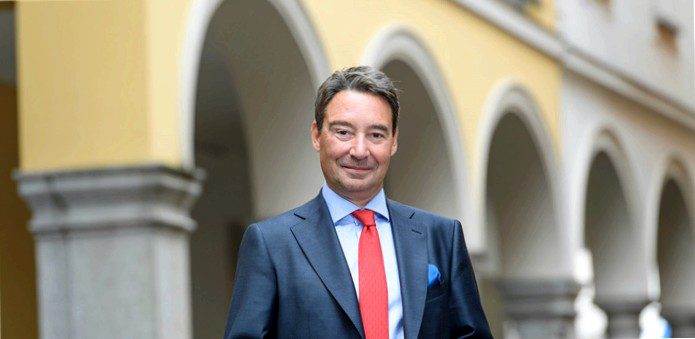
The impact of the corona pandemic on the financial world has been and will be devastating. How to act now, both as a company and as an individual? An interview with Serge Pavoncello, President of the Swiss Association of Asset Managers (SAAM), on current challenges and trends as well as an outlook for the future.
Serge Pavoncello, the corona pandemic has inevitably left its mark on the financial world. How do you assess the situation at present?
There is much we still do not know. What is clear is that there is still a lot of uncertainty about how things will develop. In my opinion, we are currently in a situation like after a strong earthquake or a very big thunderstorm. Things were stable for a long time and suddenly a drastic event changes everything. The cessation or even the deceleration of part of the economic activity during this crisis has significant economic and structural consequences. Some sectors are suffering more than others, and the impact will be felt in the long term. As far as the financial markets are concerned, we can be satisfied with the good performance and the current level compared to the economic impact that we will inevitably suffer. On the other hand, the stock market indices hide large discrepancies between sectors, but this makes sense.
Has the Corona crisis also created opportunities for certain sectors??
Of course – a good example is the entire technology sector, especially all companies where there is the possibility to work decentrally. The same goes for those who make it possible in the first place, for example with the right software. This is an industry that has benefited enormously from the situation and has helped us a lot during this time. Otherwise, the reputation and value of sectors such as biotech and pharmaceuticals have also risen again.
Crises on the markets are nothing new. For example, what lessons can we learn from the global economic crisis of 2007 to 2012??
In 2007, the nature of the economic crisis was completely different. This took its course through an enormous problem in the USA with an overvaluation of the real estate market. For many reasons that are known today, the crisis led to numerous difficulties such as liquidity crisis, over-indebtedness, questionable valuation of financial products, etc. But now we are facing a crisis of a different kind. In terms of lessons to be learned, I tend to think of the phases of European reconstruction after the Second World War or the economic revival of the new agreement in the 1930s.
Although I am a passionate liberal, I am convinced of the following: the state plays a fundamental role in these crises by regulating society in challenging times, thus preventing the system from going under, which would have severe social consequences. From this point of view, I note that Switzerland has taken a pragmatic approach to this health crisis. In the course of this, a reasonable functioning of our economy has been made possible – although with great caution. Maintaining the economy was of great importance; especially when the corona pandemic was running its course very quickly. If our authorities had not made this "flexibility" possible, I think we would be in a much worse economic situation.
The state plays a supporting role in these crises by regulating society in challenging times and thus not letting the system go down, which would have serious social consequences. Serge Pavoncello
What drew you personally to the world of finance?
I was told at the time that it was difficult to find work after graduating from school. So I figured I might as well do what I wanted to do. In my case, it was to work in the financial world. I was motivated to learn everything. After graduating, I decided to do a one-year postgraduate internship at UBS, where I worked in various departments. Subsequently, I got into a portfolio management service. There we have done great things and influenced the progress and development of part of the bank's economic activity. I have also done additional postgraduate studies. In short, these years have been fantastic in terms of my knowledge growth and have undeniably shaped me and also allowed me during my career to carry out all the different projects as well as to manage companies.
There are certain cliches about your profession. An example is that of the financial shark who does everything to achieve his goals. How do you rate these cliches?
I think that many popular movies have brought this stereotype to its peak. Unfortunately, just like everywhere else, there is a fringe of the population that cheats and does things you shouldn't do. It would be naive to think that this type of behavior will disappear. We rely on effective and well thought-out rules that control certain areas and protect customers, while giving professionals in the industry the leeway they need to work efficiently. This is one of the reasons for my commitment to the Swiss financial center. To return to your question, I would like to point out that the financial sharks mentioned are the exception rather than the norm. I am convinced that most people who work in our industry are well-meaning and would also like to pass on the corresponding values to their customers.
Do you think bank employees should one day fear being replaced by computers?
This question depends on how the bank wants to position itself. It's a choice between an efficient and institutional management of their clients or a more personalized way. This is a big constant in the economy, but I doubt that this replacement will happen. Fashion can serve as an illustration: On the one hand there are the common brands and on the other hand there is haute couture. Basically, we target a different type of customer each time, but always the needs of the customer are the basis of an offer that must be relevant.
The mentioned financial sharks are rather the exception than the norm. Serge Pavoncello
We are clearly talking about two different things. On the one hand, we have a product whose goal is to have the lowest cost and which can be distributed on a large scale. On the other hand, we have a product that brings a high contribution to cover and is intended only for a reduced number of customers. It's the same in finance: if you want to manage a high number of clients who want traditional or more common management, it's perfectly possible to use technology, whereas in the past these activities had to be done by several employees. In my opinion, the management carried out by independent asset management companies and banks will continue to coexist, since both the characteristic of personalization and privileged contact and the need for mass management will remain.
What advice would you give to young people interested in a career in this field?
Pay special attention to acquiring knowledge especially in the beginning of their career. This is the be-all and end-all. There are several ways to do this. It is also important to have a technical understanding in order to understand the mechanisms of the industry and the services to be provided, both now and in the future. There is no silver bullet to achieve this. You can do this by working in a corporation or in a much smaller company that is more technically oriented. Above all, there is no point in having regrets: you have to make decisions and look ahead. It is important to be at peace with the function you are performing and to know what you are responsible for.
You have to make decisions and look ahead. Serge Pavoncello
Given the current situation, what are your tips for a safe investment?
At the moment we are in a catch-up phase. Because, as I said, some technology companies have benefited greatly from this period for good reason. However, I would not recommend investing in them now, as some companies tend to be overvalued. I would rather consider short-term opportunities, which unfortunately have fallen sharply and for the wrong reasons. Now is the right time to work on new fundamentals and get informed about investments.
How will the financial markets develop in the medium and long term?
At the moment, we can expect the financial markets to face a crisis of rather small magnitude with little long-term impact after the rallies of the last weeks. Future development will be strongly influenced, apart from the important factor of "liquidity", by a possible recovery of the epidemic. In this case, the economy and the markets will suffer. The second point has to do with the development of the economy, even without recovery from the epidemic; as I said, I have a feeling that we don't expect a big impact. If economic figures and activities are weaker than expected in the coming months, we will still face a difficult time.
About Serge Pavoncello
Serge Pavoncello graduated with a bachelor's degree in economics from the University of Geneva and started his career in 1987 at UBS in portfolio management. As a director of this banking institution, he was involved in the creation of the central administration service (services gestion centralisee) for the UBS Group (Geneva, Zurich, Basel and Lugano) and was part of the investment committee for private clients.
In 1995, he joined the board of the Swiss Financial Analysts Association (SFAA), where he developed AZEK, an SFAA-founded financial education institute, from scratch with.
In 1999, Serge Pavoncello joined Credit Suisse, where he became director of the onshore private banking unit. Five years later, he left the bank to found Wedge Associates SA – a multi-family office whose main objective is to offer its clients a range of comprehensive and efficient services.
In addition to his work at Wedge Associates SA, Serge Pavoncello joined the board of the Swiss Association of Asset Managers (SAAM), the umbrella organization of independent management companies. In this context, he is involved in several major projects to develop the profession of independent wealth advisors and managers. In May 2017, Serge Pavoncello was appointed president of SAAM.