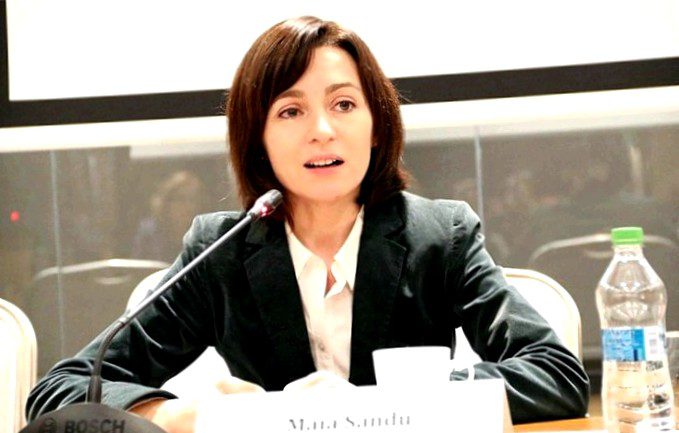
In Moldova, the party of Berlin's favorite, the country's neoliberal president, Maia Sandu, won Sunday's parliamentary election. According to the preliminary election results, the EU-oriented Action and Solidarity Party (PAS) was able to prevail with around 52 percent against the Socialists around ex-president Igor Dodon, who are more inclined towards Russia. Berlin had openly intervened in the election campaign: PAS ex-leader Sandu, who remains its best-known representative, had been received in the German capital by German Chancellor Angela Merkel and German President Frank-Walter Steinmeier, among others; German support for her and her party recently even included media publications aimed at influencing public opinion in the southeastern European country. Sandu and the PAS have been supported by the German government and German foundations for years – with the aim of gaining the upper hand in Moldova in the power struggle against Russia. In the steady battle, Sandu's pro-EU group now provides the president as well as the largest faction in parliament.
Compromise of the Great Powers
After a fierce state crisis in the summer of 2019, in which there had been two parallel governments in the interim, the pro-Russia Socialists (PSRM) and the pro-EU Liberal Conservatives formed a joint government – mediated by ambassadors from outside powers.[1] Former World Bank employee Maia Sandu received the post of prime minister in Chisinău. One of her few trips abroad took her to Germany, where she met Chancellor Angela Merkel (CDU) and visited the CDU-affiliated Konrad Adenauer Foundation, among others.[2] Merkel stated that Berlin wholeheartedly supported the "reforms" envisioned by Sandu.[3] However, after losing a confidence vote, Sandu resigned as early as November 2019; she stated that there was "a great risk" that "Moldova will now lose the support of international donors again".[4]
Germany's favorite
Sandu had already met with Chancellor Merkel shortly before the 2016 presidential election, which she lost to socialist candidate Igor Dodon at the time, indicating the German leader's support for the neoliberal politician.[5] The European People's Party (EPP), in which the CDU plays a dominant role, had sent staff to Moldova for Sandu's election campaign, although Sandu's party, the Party of Action and Solidarity (PAS), does not belong to the EPP. Shortly before the elections, the EPP also issued a press statement saying that Sandu "represents the change Moldova needs".[6]
Swing to Moscow
Sandu was succeeded in the post of prime minister in November 2019 by Ion Chicu, a nonpartisan whose cabinet was dominated by the Socialists. Chicu's first trip abroad was to Moscow. The Russian government used the occasion to offer Moldova a $500 million low-interest loan.[7] Thus, contrary to Sandu's predictions, the new Moldovan government quickly found backers, albeit from outside the West. Despite improved relations with Moscow, the new government in Chisinău also sent cooperative signals to Germany and appointed the former Moldovan ambassador in Berlin as its new foreign minister.[8] A Republic of Moldova under strong Russian influence with a German junior role – this is what Chancellor Merkel and then Russian President Medvedev had discussed a decade ago.[9]
Surprising election victory
But the pro-Russian politicians lost massive support among the population during 2020. Prime Minister Chicu's government resigned over its mismanagement of the Covid 19 pandemic in December 2020. At the end of 2020, ex-Prime Minister Sandu won the presidential elections. A quarter of the votes for them came from abroad – from Moldovans who have emigrated to wealthier countries to earn a living there.[10] In keeping with her connections, the new president Sandu immediately received advance praise from Union circles: According to the Konrad Adenauer Foundation's bureau chief in Chisinău, she "credibly and courageously embodies a democratic and constitutional change.".[11] However, there is a wide gap between Sandu's presentation in the West and her actual actions in the country.
On the brink of constitutionality
Although Moldova is a parliamentary republic, newly elected President Sandu, after her election victory in late 2020, argued that her electoral mandate gave her the right as president to dissolve parliament. However, since this is only possible in Moldova if there is no functioning government for three months, Sandu prevented the formation of a new Socialist government. A critical observer of the political scene in Moldova judged her maneuvers as putting the "mandate she got by winning the presidential election above the constitutionality of her actions" instead of "respect[ing] the rule of law and put[ting] her mandate aside".[12]
Vaccine diplomacy
In the constant battle between the pro-West and pro-East factions in Moldova, the vaccination campaign in the fight against the Covid 19 pandemic is bringing new setbacks to the pro-EU forces. As the European Council on Foreign Relations (ECFR) noted back in May, the EU is "less present than other powers" in the field of vaccine diplomacy.[13] This is also true of Moldova. In February 2021, the country initially received only 21.600 vaccine doses from Romania. In March, several thousand doses followed from WHO's COVAX program. In the same month, Moldova won 2.000 doses of the Chinese vaccine Sinopharm – supplied as a donation from the United Arab Emirates – and nearly 50 doses of the Chinese vaccine Sinopharm.Re-book 000 cans from Romania. The country received its first pledges for large vaccine deliveries in April – from Russia and China. Both countries announced that they would provide the republic with a total of more than 330.000 doses of vaccine to be donated.[14] President Sandu responded by turning to the German government for help. In response, the German Defense Ministry sent 28 trucks with gloves, masks, respirators and other supplies, which the German ambassador handed over to the president in a high-profile ceremony.[15] However, Germany is not supplying vaccines so far, which once again puts EU countries behind in Moldova's vaccination campaign. In return, Washington announced it would begin delivering 500.000 vaccine doses to outdo the competition. The first 150.000 doses should arrive yesterday in Chisinău.[16]